📑 Table of Contents
- The Indian Mathematical Olympiad pathway
- IOQM 2026: key dates so far
- How RMO selection works after IOQM
- The big shift: from answers to proofs
- The four Olympiad areas and what to learn
- A 5-week plan from IOQM result to RMO
- A sample weekly schedule
- Exam-day tips for proof-based papers
- How proof-based papers are graded
- After RMO: INMO, IMOTC and IMO
- Why the Olympiad journey is worth it — even if you stop early
- Balancing Olympiad preparation with school and JEE
- Resources and practice habits
- Stay informed from official sources
- If you did not qualify for RMO this year
- Common mistakes students make after IOQM
For thousands of school students, the IOQM result is the first big milestone in the Mathematical Olympiad journey. But the questions that follow are always the same: What is the IOQM cut-off for RMO? What happens after IOQM? How is RMO different? How do students reach the IMO? This guide answers them all — the full pathway from IOQM to IMO, how selection works at each stage, how preparation must change once you move from integer-answer questions to proof-based exams, and a practical plan for the weeks after the IOQM result.
For the latest IOQM 2026 result status and links, see our IOQM Result 2026 page.
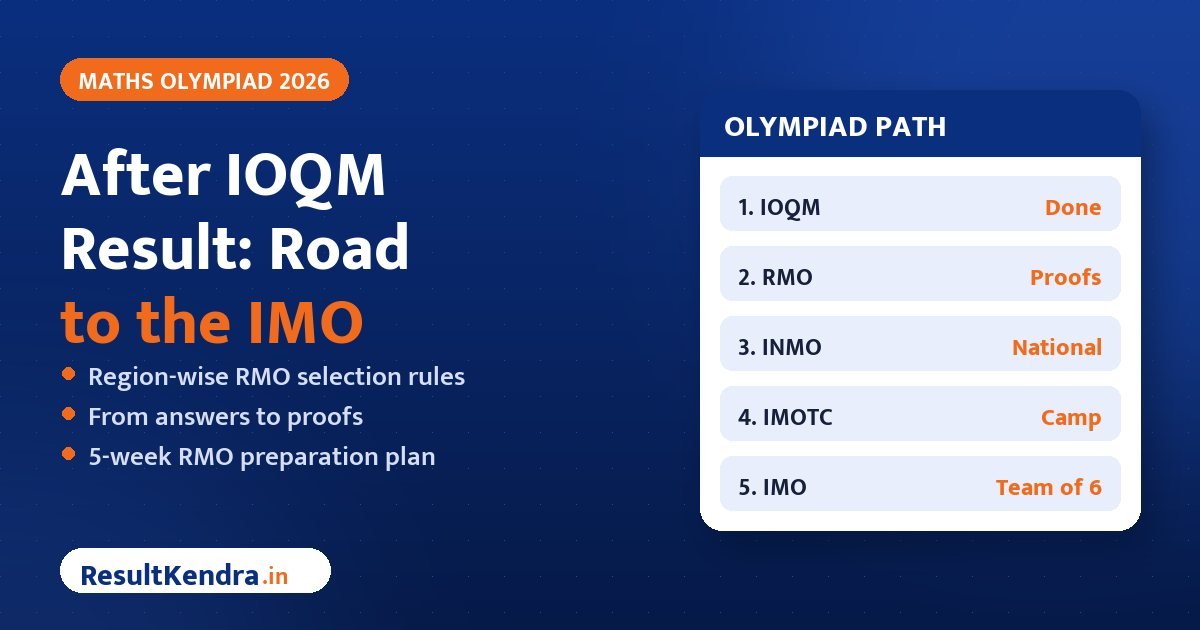
The Indian Mathematical Olympiad pathway
| Stage | Format | Who takes it |
|---|---|---|
| IOQM | 30 integer-answer questions, 100 marks, 3 hours, no negative marking | Open to eligible school students (Classes 8–12) |
| RMO | Proof-based written exam | Students selected region-wise and class-wise from IOQM |
| INMO | Proof-based written exam at national level | Top performers in RMO |
| IMOTC | Training camp with selection tests at HBCSE, Mumbai | Top INMO performers |
| IMO | International Mathematical Olympiad | Team of six selected from the camp |
The Olympiad programme in mathematics is coordinated by the Homi Bhabha Centre for Science Education (HBCSE), TIFR, with IOQM conducted by the Mathematics Teachers’ Association (India). Official information is published on olympiads.hbcse.tifr.res.in and www.mtai.org.in.
IOQM 2026: key dates so far
| Event | Date |
|---|---|
| IOQM exam | 6 September 2026 |
| Provisional scores | 7 October 2026 |
| Score challenge closed | 9 October 2026, 6:00 PM |
| RMO cut-offs | To be announced by MTA(I) |
| RMO | Reported for 15 November 2026 |
How RMO selection works after IOQM
As reported from the official rules for this cycle, IOQM-to-RMO selection works like this:
- A student must score at least 10% of the total IOQM marks to be eligible. This is only a minimum threshold.
- Selection is region-wise, so students compete with others in their own region.
- Category A (Classes 8–11): the top 200 eligible students of each region, including ties at the last position.
- Category B (Class 12): the top 40 eligible students of each region, including ties at the last position.
- Five additional girls in Category A per region, including ties.
Because of this structure, there is no national “IOQM cut-off”. A score that qualifies in one region may fall short in another. Read the official notice from MTA(I) for the final rules and published cut-offs.
The big shift: from answers to proofs
IOQM rewards getting the right number. RMO and INMO reward complete, rigorous reasoning. A correct final answer with no justification may earn little; a well-argued partial solution can earn substantial credit. This is the single most important change for students moving beyond IOQM.
What a good Olympiad solution looks like
- States clearly what is being proved and any notation used.
- Proceeds in logical steps, each justified by a known result or a previous step.
- Handles all cases — no hidden assumptions such as “without loss of generality” unless it is truly justified.
- Ends with a clear conclusion.
- Is readable: diagrams in geometry, clear algebra, and short explanations between equations.
A short example of proof-writing
Problem: Prove that n³ − n is divisible by 6 for every integer n.
A weak answer: “Try n = 2: 8 − 2 = 6. Try n = 3: 27 − 3 = 24. So it is always divisible by 6.” Checking examples is not a proof.
A complete proof: Factorise n³ − n = (n − 1) · n · (n + 1). This is the product of three consecutive integers. Among any two consecutive integers, one is even, so the product is divisible by 2. Among any three consecutive integers, exactly one is a multiple of 3, so the product is divisible by 3. Since 2 and 3 are coprime, the product is divisible by 2 × 3 = 6. ∎
Notice how every step is justified and the conclusion follows clearly. This is the style RMO graders look for.
The four Olympiad areas and what to learn
1. Algebra
Inequalities (AM-GM, Cauchy-Schwarz, rearrangement), polynomials and their roots (Vieta’s relations), functional equations, sequences and series. Start with classical inequalities and simple functional equations.
2. Number theory
Divisibility, primes, gcd and lcm, modular arithmetic, Fermat’s little theorem, Diophantine equations and parity arguments. Number theory problems reward careful case work and clean modular reasoning.
3. Combinatorics
Counting principles, bijections, the pigeonhole principle, invariants and monovariants, graph-theory basics and games. Combinatorics is often the hardest area for students because it depends more on ideas than on formulas — practise a wide variety of problems.
4. Geometry
Angle chasing, similar triangles, cyclic quadrilaterals, power of a point, triangle centres, and basic trigonometric and coordinate methods. Draw accurate, large diagrams; many geometry insights come from a good figure.
A 5-week plan from IOQM result to RMO
| Week | Focus | Practice |
|---|---|---|
| 1 | Proof-writing basics; induction and contradiction | Write full solutions to 10 past RMO problems |
| 2 | Number theory and algebra | Two topic sets daily; get solutions reviewed |
| 3 | Geometry | Angle chasing and cyclic quadrilateral problems with full proofs |
| 4 | Combinatorics | Pigeonhole, invariants and counting problems |
| 5 | Full past papers under time limits | Three timed papers; review every solution for gaps |
A sample weekly schedule
| Day | Olympiad work (about 1.5–2 hours) |
|---|---|
| Monday | Number theory: two problems with full written solutions |
| Tuesday | Review Monday’s solutions; read one model solution carefully |
| Wednesday | Geometry: draw large diagrams, solve two problems |
| Thursday | Algebra: inequalities or functional equations |
| Friday | Combinatorics: one hard problem, take your time |
| Saturday | Timed past paper (or half paper) |
| Sunday | Analyse the paper, update your problem journal, rest |
Adjust the schedule around school exams, but try to keep at least four Olympiad sessions a week in the weeks before RMO.
Exam-day tips for proof-based papers
- Read every problem first and spend a few minutes on each before committing.
- Start with the problem you are most confident about to build momentum.
- Write partial progress even if you cannot finish — key lemmas and special cases can earn credit.
- Keep rough work separate and present the final solution neatly.
- Check that every claim in your solution is justified.
How proof-based papers are graded
In RMO and INMO, each problem carries marks and graders award credit for progress, not only for the final result. A correct, complete proof earns full marks. A solution with a small gap may lose a few marks, while a solution that proves a key intermediate claim or handles an important special case can still earn partial credit. On the other hand, a correct answer stated without justification usually earns very little. This is why clear structure matters: state the lemmas you prove, separate cases clearly and write a conclusion, so that graders can follow — and reward — your reasoning.
After RMO: INMO, IMOTC and IMO
Students who perform best in RMO are invited to write INMO, the national-level proof-based Olympiad. Top INMO performers attend the IMO Training Camp at HBCSE, where a series of selection tests is held. Six students are finally chosen to represent India at the International Mathematical Olympiad. Each stage is more demanding than the last, and the training camp itself is a valuable experience in advanced problem solving. Exact dates and rules for each stage are published by HBCSE and MTA(I) every year.
Why the Olympiad journey is worth it — even if you stop early
- It builds deep problem-solving ability that helps in JEE, other entrance exams and university mathematics.
- Proof-writing trains clear, logical thinking and communication.
- Recognition at Olympiad stages is valued by many institutions and programmes.
- Students meet peers who share their interest in mathematics.
Balancing Olympiad preparation with school and JEE
Many students worry that Olympiad preparation will hurt their board or JEE studies. In practice, the skills overlap more than they conflict. A sensible balance is to set aside a fixed number of hours each week for Olympiad problems — for example, two focused evenings and part of the weekend — while keeping school and entrance-exam work on track. Use Olympiad number theory and inequalities to strengthen your JEE algebra, and use JEE practice to keep your calculation speed sharp. Close to RMO, shift more time to proof-writing for a few weeks, then return to your regular schedule.
Resources and practice habits
- Past papers: previous IOQM, RMO and INMO papers are the most valuable resource. Solve them under time limits and then study good solutions.
- Problem journals: keep a notebook of problems you could not solve, the key idea you missed and a one-line summary of the solution. Revisit it every week.
- Topic sheets: group problems by technique (pigeonhole, invariants, AM-GM, cyclic quadrilaterals) so that you learn to recognise patterns.
- Study groups: discussing problems with friends helps you see different approaches and improves how you explain your reasoning.
- Official information: check olympiads.hbcse.tifr.res.in and www.mtai.org.in for syllabus notes, rules and announcements.
Stay informed from official sources
Dates, cut-offs and rules can change from year to year. For accurate information, follow the official announcements on ioqm.mtai.org.in, www.mtai.org.in and olympiads.hbcse.tifr.res.in. Coaching websites can be useful for practice material, but cut-off predictions and “expected dates” published there are estimates, not official decisions.
If you did not qualify for RMO this year
Do not be discouraged. If you are in Class 8, 9, 10 or 11, you can appear again next year — and the gap is often smaller than it looks. Analyse your IOQM paper: which areas cost you the most marks? Build a weekly routine with past IOQM papers for speed and accuracy, and gradually add proof-based problems so that you are ready for RMO when you qualify. Many successful Olympiad students qualified only in their second or third attempt.
Common mistakes students make after IOQM
- Waiting for the RMO cut-off before starting proof practice.
- Solving problems only “in the head” without writing full solutions.
- Studying only algebra and number theory and avoiding combinatorics and geometry.
- Comparing scores with students from other regions.
- Relying on unofficial cut-off predictions.
Keep checking our IOQM result 2026 page for the RMO cut-off and selection list. All the best for RMO! ➗
Frequently Asked Questions
What happens after the IOQM result?
Students selected through the region-wise, class-wise cut-offs appear for the Regional Mathematical Olympiad (RMO), then INMO, IMOTC and finally IMO.
How many students qualify for RMO from IOQM?
As reported, the top 200 eligible students in Classes 8–11 and the top 40 in Class 12 per region, plus five additional girls in Category A, subject to a 10% minimum score.
Is RMO different from IOQM?
Yes. IOQM has integer-answer questions; RMO is a proof-based written exam where complete reasoning earns marks.
When is RMO 2026?
RMO 2026 is reported for 15 November 2026. Confirm on the official MTA(I) and HBCSE websites.
What topics are tested in RMO?
Algebra, number theory, combinatorics and geometry at Olympiad level.