📑 Table of Contents
- What is an answer key? Provisional vs final key
- How to download your response sheet
- Formula to calculate your score
- What is normalisation and why does your score change?
- How to raise an answer key objection (step by step)
- How to judge your chances against the cut-off
- How to calculate your score in OMR exams
- Dropped questions and bonus marks
- Preparation plan after the answer key
- Common mistakes candidates make
- What happens after the final answer key?
- Unattempted questions get zero — no negative marking.
- Multi-shift exams may use normalisation, so your final marks can differ slightly.
The answer key is the first real feedback after weeks or months of preparation. Used correctly, it tells you your expected score, your chances of clearing the cut-off and whether you should start preparing for the next stage right away. Used carelessly, it leads to wrong calculations, false hope or unnecessary panic.
This guide explains everything step by step: what a provisional and final answer key are, how to read your response sheet, how to calculate your score for exams with and without negative marking, how normalisation works, and how to raise an objection correctly so that a wrong answer in the key does not cost you marks.
What is an answer key? Provisional vs final key
An answer key is the official list of correct answers for every question in the exam, released by the conducting body. Most government exams follow a two-step process:
| Provisional (tentative) answer key | Final answer key | |
|---|---|---|
| When | A few days to a few weeks after the exam | After objections are reviewed — often with or just before the result |
| Purpose | Lets candidates check answers and challenge mistakes | Used to prepare the result |
| Can you object? | Yes, within the window given | No — it is final |
| Changes | — | Some answers may be changed, or questions dropped / bonus marks given |
For example, a commission may announce that certain questions have been dropped and all candidates get marks for them, or that two options are both accepted as correct. Such changes appear only in the final key, so your expected score may move up or down a little.
How to download your response sheet
In computer-based exams (SSC, RRB, IBPS, NTA and most state exams now), you get a personal response sheet that shows every question, the option you chose and the correct option as per the provisional key.
- Open the official website and find the “Answer Key” or “Response Sheet” notice for your exam.
- Click the candidate login link given in the notice.
- Log in with your registration / roll number and password or date of birth.
- Open the response sheet. Download or print it immediately — the link is usually open only for a limited period.
In pen-and-paper (OMR) exams, the body usually publishes question-paper-wise answer keys (Set A, B, C, D). Make sure you use the key for your booklet series — using the wrong series is one of the most common calculation mistakes.
Formula to calculate your score
The basic formula works for almost every objective exam:
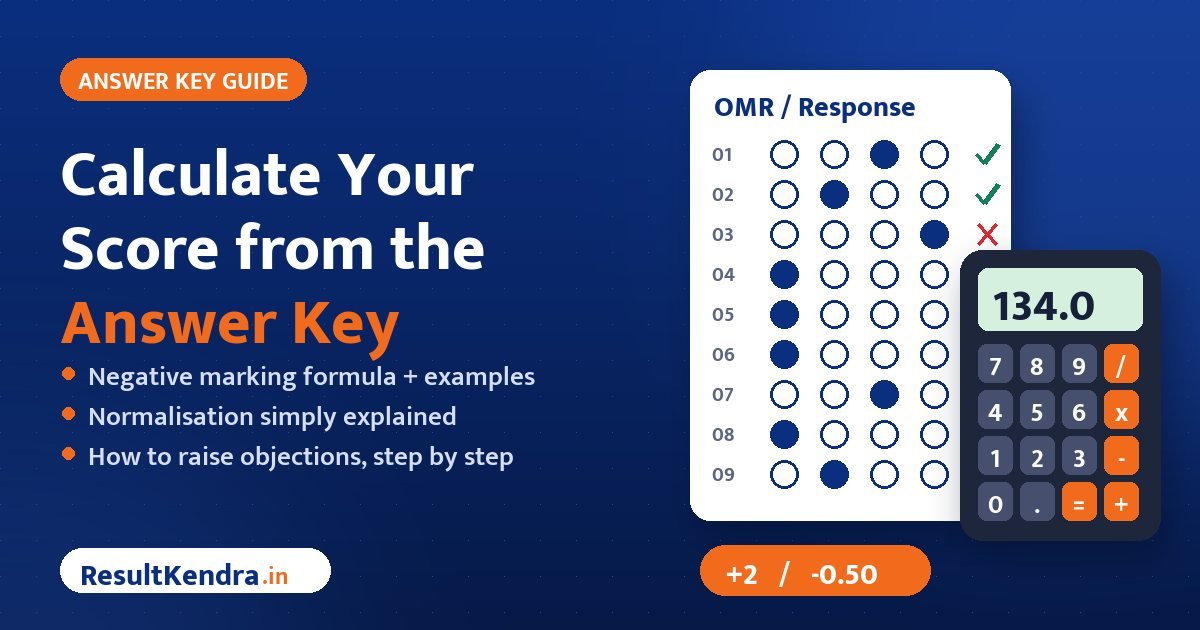
Total score = (Number of correct answers × marks per question) − (Number of wrong answers × negative marks per question)
Unattempted questions do not add or subtract anything. To use the formula you need the marking scheme of your exam, which is always given in the official notification.
Common marking schemes (check your notification)
| Exam | Marks per correct answer | Negative marking |
|---|---|---|
| SSC CGL / CHSL Tier-I (100 questions, 200 marks) | +2 | −0.50 per wrong answer |
| RRB NTPC / Group D CBT | +1 | −1/3 mark per wrong answer |
| IBPS / SBI PO & Clerk | As assigned to the question | −1/4 of the marks of that question |
| UPSC Civil Services Prelims (GS Paper I) | +2 | −1/3 of the marks of that question (≈ −0.66) |
| TNPSC Group 1 Prelims (200 questions, 300 marks) | +1.5 | No negative marking |
Exam patterns are revised from time to time, so always confirm with the latest notification of your exam before calculating.
Example 1: SSC CGL Tier-I
Suppose you attempted 82 questions out of 100. After matching with the key you have 70 correct and 12 wrong.
- Marks for correct answers: 70 × 2 = 140
- Negative marks: 12 × 0.50 = 6
- Raw score = 140 − 6 = 134 out of 200
Example 2: RRB Group D
Suppose you attempted 85 questions out of 100, with 72 correct and 13 wrong.
- Marks for correct answers: 72 × 1 = 72
- Negative marks: 13 × 1/3 = 4.33
- Raw score = 72 − 4.33 = 67.67 out of 100
Example 3: Exam without negative marking
In an exam with 1.5 marks per question and no negative marking, 140 correct answers give 140 × 1.5 = 210 out of 300. Here, attempting every question is clearly beneficial because a wrong answer costs nothing.
Section-wise calculation
Many exams have sectional cut-offs or qualifying sections (for example, some Tier-II papers or banking prelims). Calculate your score section by section, not only the total. Clearing the overall cut-off is not enough if you are below the sectional minimum.
What is normalisation and why does your score change?
When an exam is conducted in many shifts over several days, it is nearly impossible to make every paper equally difficult. To be fair, bodies such as SSC and RRB convert each candidate’s raw score into a normalised score using a statistical method announced in their notices.
- If your shift was tougher than average, your normalised score may be higher than your raw score.
- If your shift was easier, your normalised score may be lower.
- The change is usually small, but it can matter near the cut-off.
So treat the score you calculate from the answer key as your raw score. The marks shown with the result are the ones that count. Avoid trusting “normalised score calculators” from unofficial sources — they can only guess, because the real method uses data from all candidates.
How to raise an answer key objection (step by step)
If you are sure an answer in the provisional key is wrong, raise an objection. A successful objection can change the answer for every candidate and directly affect cut-offs.
- Note the exact question. Write down the question ID (in CBT exams) or question number and booklet series (in OMR exams).
- Collect proof. Use standard textbooks (NCERT for school-level subjects), official government reports, the Constitution, Acts, or reputable reference books. Take a clear photo or scan of the relevant page.
- Log in to the objection link given in the answer key notice, using your registration number and password.
- Select the question and choose the answer you believe is correct.
- Write a short, clear justification — two or three sentences explaining why the key is wrong, and mention your source with page number.
- Upload the proof in the allowed format (usually PDF or JPG within a size limit).
- Pay the fee, if required. Many bodies charge a fee per question challenged. In its 2026 notices, SSC has charged ₹50 per question (down from ₹100 earlier), NTA has charged ₹200 per question, and some boards refund the fee if the objection is accepted. The amount is set in each notice.
- Submit before the deadline and save the acknowledgement or payment receipt.
How to write a strong objection
- Challenge only questions where you are confident and have a reliable source.
- Avoid YouTube videos or coaching “answer keys” as proof — use primary or standard sources.
- Keep the explanation factual. Expert committees go through thousands of objections; a clear, short note works best.
- If a question itself is wrong (no correct option, two correct options, or a translation error between Hindi and English versions), say so clearly and ask for the question to be dropped or both options to be accepted.
How to judge your chances against the cut-off
Once you have your expected score, compare it with:
- Previous years’ official cut-offs for the same exam and your category (released by the commission with past results).
- Number of vacancies this year compared with previous years — more vacancies usually mean a lower cut-off.
- Difficulty level of this year’s paper, as reflected in your own experience and the overall shift analysis.
Treat any “expected cut-off” published by coaching websites as a rough guess, not a promise. If your score is clearly above previous cut-offs, start preparing for the next stage immediately. If you are close to the line, keep preparing anyway — waiting idle for the result is the costliest mistake.
How to calculate your score in OMR exams
Many state exams, police recruitments and TETs are still conducted on OMR sheets. Since there is no online response sheet, calculating the score needs a little more care:
- Find your booklet series (A, B, C, D or a numeric code) — it is printed on the question paper and you also marked it on the OMR sheet.
- Use the carbon copy or your own notes. Some exams give a carbon copy of the OMR sheet; otherwise use the answers you marked on the question paper, if allowed.
- Download the correct series key from the official website.
- Tick and cross on a printed copy of the key so you do not lose count, then apply the formula.
- Wait for the scanned OMR — some bodies release the scanned OMR images later, which let you confirm your exact responses.
Remember that OMR sheets are machine-read. A lightly filled bubble, two bubbles in one row or stray marks can make a response invalid, so your official score may be slightly lower than your own count.
Dropped questions and bonus marks
When a question is wrong or ambiguous, the final key may say “dropped”, “bonus” or “all options correct”. How it affects you depends on the rule stated in the notice:
- Bonus to all: every candidate gets full marks for that question, whether or not they attempted it. Add the marks to your score.
- Multiple options accepted: if you chose any of the accepted options, count it as correct.
- Question deleted and marks redistributed: some bodies remove the question and scale the remaining marks proportionally. Use the method described in the official notice.
Because these decisions come only with the final key, keep a small margin of 2–4 marks in mind when judging your chances from the provisional key.
Preparation plan after the answer key
Do not lose the weeks between the answer key and the result. A simple plan:
- Clearly above the expected cut-off: start the next stage immediately — Tier-II, Mains, typing / skill test or physical test. Collect your documents for verification too.
- Close to the cut-off: prepare for the next stage and also revise for upcoming exams. Either way, the effort is not wasted.
- Below the cut-off: analyse the response sheet section by section. Find the topics where you lost the most marks and note how many negative marks you took. This analysis is the most valuable preparation for your next attempt.
Common mistakes candidates make
- Using the wrong booklet series in OMR exams.
- Ignoring negative marking or using the wrong fraction (1/3 vs 1/4 vs 0.50).
- Counting “marked for review” questions as answered when no option was selected.
- Not downloading the response sheet while the link is open — you may need it later.
- Missing the objection deadline by waiting for someone else to “confirm” a wrong answer.
- Trusting unofficial answer keys released minutes after the exam, which often contain mistakes.
What happens after the final answer key?
After the objection window closes, an expert committee reviews all challenges. The body then publishes the final key — sometimes along with the result, sometimes a little before it. Questions may be dropped and bonus marks given. The result and cut-off are prepared using this final key and, where applicable, normalisation.
Keep an eye on our Answer Key section for the latest provisional and final keys, and on Upcoming Results to see which results are due next. When the result is out, follow our guide on how to check your Sarkari result. And if you have another exam coming up, read admit card problems and their solutions before exam day.
Calculate carefully, object wisely, and keep preparing — the next stage begins the day you finish this one. 💪
Frequently Asked Questions
How do I calculate my score from the answer key?
Count correct and wrong answers from your response sheet, then use: Score = (Correct × marks per question) − (Wrong × negative marks). Unattempted questions get zero.
What is the negative marking in SSC CGL?
In SSC CGL and CHSL Tier-I, each correct answer carries 2 marks and 0.50 marks are deducted for every wrong answer. Always confirm with the latest notification.
Why is my normalised score different from my raw score?
When an exam runs in many shifts, the commission adjusts scores so that candidates from tougher and easier shifts can be compared fairly. Your final marks can therefore be slightly higher or lower than your raw score.
What is the fee for an answer key objection?
It differs by exam and is set in each notice. In its 2026 notices SSC has charged ₹50 per question, NTA has charged ₹200 per question, and some bodies refund the fee if the objection is accepted.
Can I raise an objection after the final answer key?
No. Objections are accepted only against the provisional key within the given window. The final answer key is used to prepare the result.